I am who I choose to become.
This is your own personal-development book — written from your actual life, not someone else's seven steps. The Scribe walks you through the heaviest things you've lived, reframes them until they propel you forward instead of holding you back, and reveals the hero's journey you were on all along. Then the proof arrives at your door: a 200–300 page hardcover memoir in your voice — ending in the life you choose now.
Begin your storyTwo children grow up in the same house. The same chaos. The same wounds.
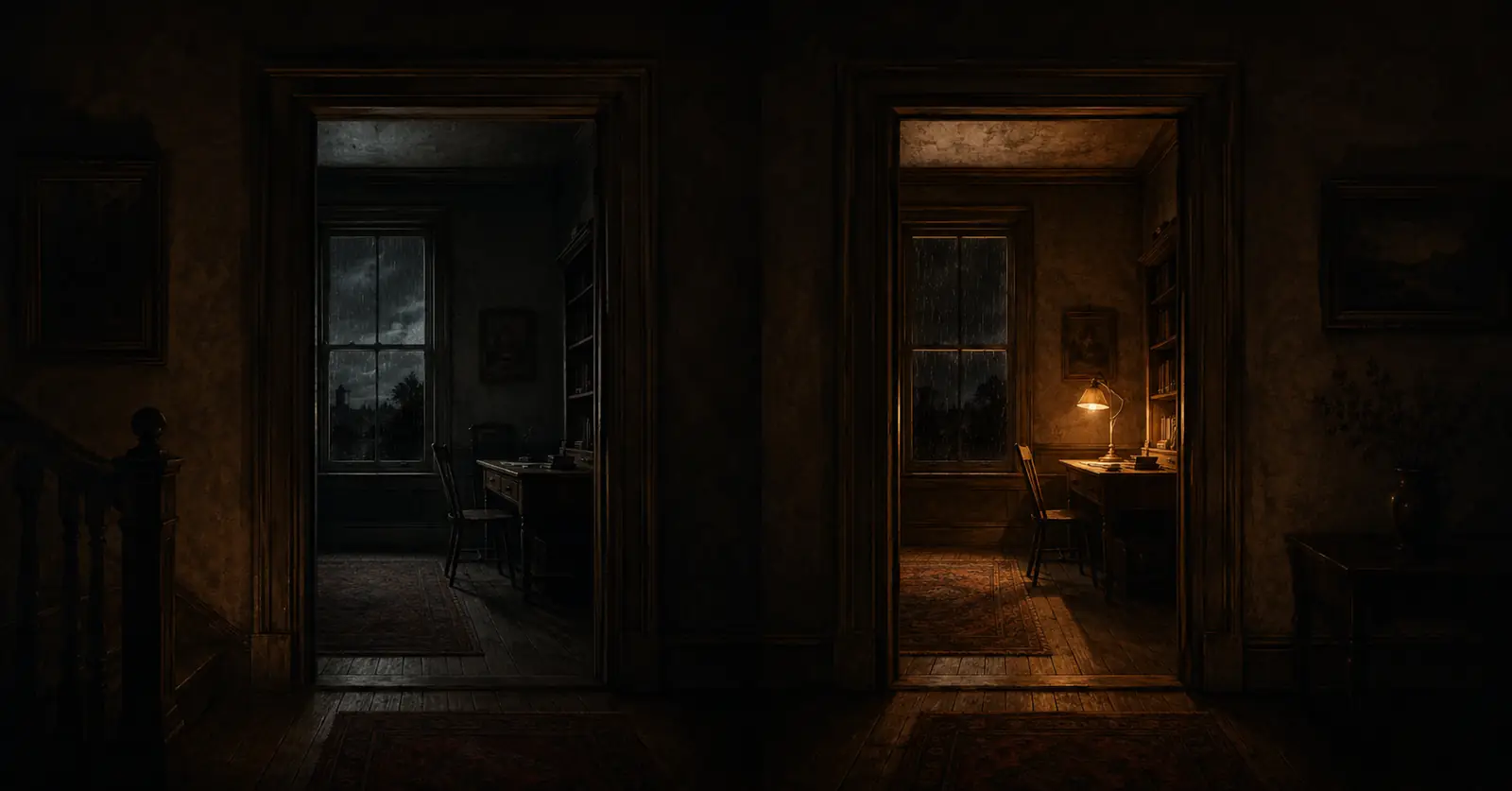
One grows up to repeat it all — the addictions, the broken relationships, the same storms wearing new names. The other becomes something no one saw coming: loving, steady, generous, unstoppable.
Same house. Same events. Same pain. So what was different?
Not what happened to them. The story each one told themselves about what it meant. One decided the chaos was proof of what they were. The other decided it was proof of what they would never be again. And neither of them chose it consciously — because the wound writes the first draft of everyone's story, and most people live their entire lives inside a draft they never knew they could edit.
This platform exists for one purpose: to hand you the pen.
You've read the books. Highlighted the chapters. Felt different — for a week.
Then the same patterns came back, because they weren't addressed in anyone else's pages. You were never going to find yourself in someone else's story. This begins somewhere no other book can: your actual life.
- "I know something shaped me."
- "I keep repeating the same patterns."
- "I've never really dealt with it."
- "I want to understand myself — deeply, finally."
If any of those are yours — your story is ready.
This is not a journaling app. Not a course. Not a memoir factory. Not therapy software.
This is a guided transformation platform. It helps you tell the truth about what happened. Understand how it shaped you. Break the patterns that kept you stuck. Own your part without drowning in shame. Forgive what needs forgiving — including yourself. And consciously choose who you become next.
The traumas you've carried get reframed — not denied, not dressed up, not explained away — until the very things that held you back become the fuel that drives you forward. The strength you built surviving becomes the strength you build with.
The book is the proof. The transformation is the product.
You give the raw truth.
The Scribe gives it form, meaning, and direction.
You don't need to be a writer. You don't need to have it figured out. You sit with the Scribe — a calm, perceptive biographer — and tell the truth the way it comes. And one thing matters more than anything else on this page: the impact of this journey is in direct proportion to your honesty. The real thing asks for the real thing — and gives it back, bound in hardcover.
I. Tell it.
Two to three hours of guided conversation
Type or speak. The Scribe asks the questions that unlock real memory — the house, the people, the moments that divided life into before and after. One question at a time. No forms. No homework.
"Tell it the way it comes. There's no rush."II. See it.
The Golden Thread revealed
Using only the evidence of your own life, the Scribe surfaces the pattern you could never see from inside it — the vow you made at seven that's still running your relationships at forty.
"It wasn't fate. It was familiarity."III. Rewrite it.
Your future, written as memory
You choose who you become — grounded in behavior, not wishful thinking. The final chapters of your book describe the life you're building in such vivid detail, it reads like it already happened.
"That future is earned. Not wished for."Seven passages. One thread.
A psychological arc refined from narrative therapy, accountability work, and the oldest story structure humans have — the hero's journey. No skipping stages. Each passage earns the next. These are the movements of the journey — your book's chapters are something else entirely: yours, titled in your own words.
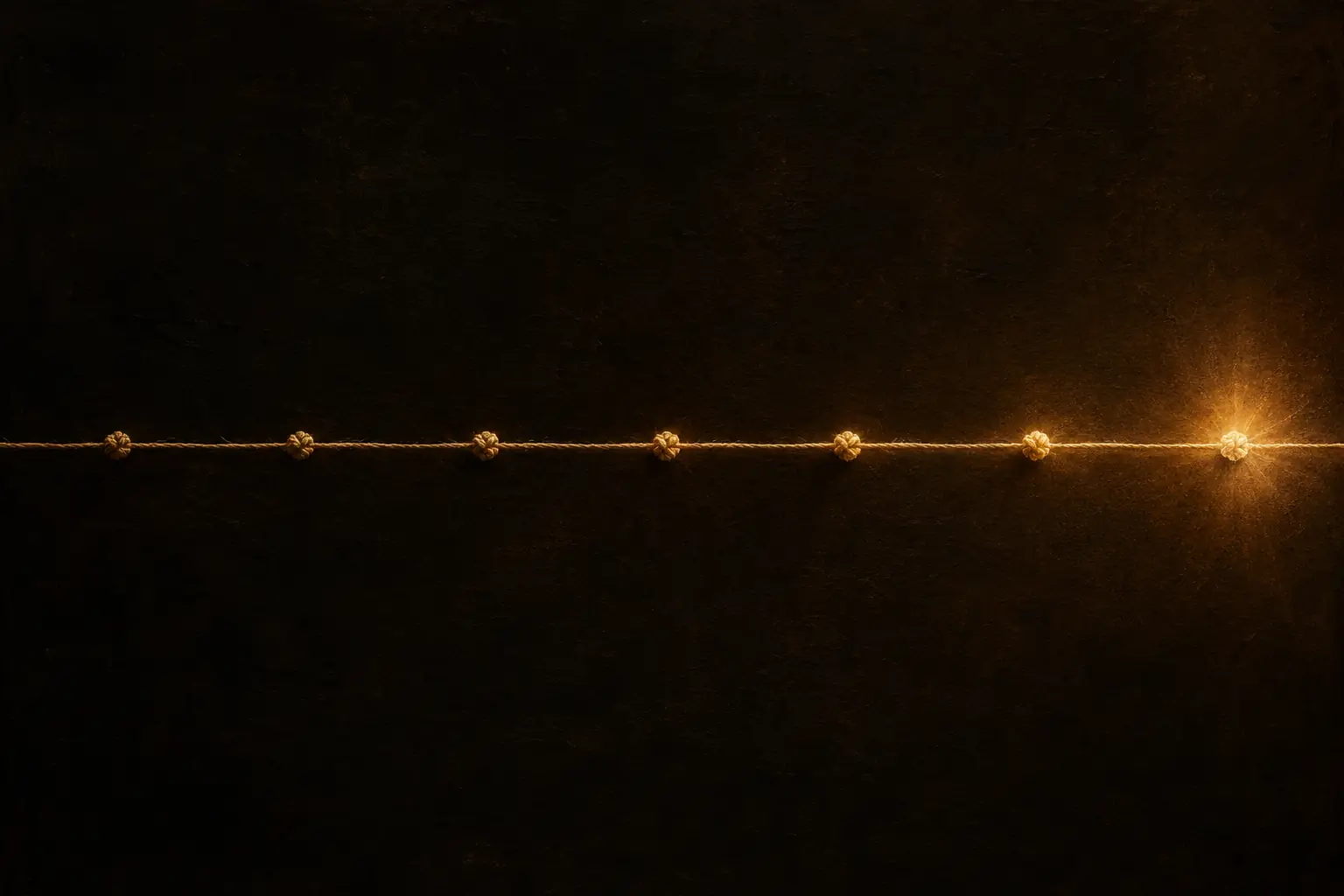
- Passage IOrigin Where your story begins — the home, the people, what safety or chaos felt like.
- Passage IIFormative Fractures The moments that shaped you, slowed down and honored with sensory truth.
- Passage IIIIdentity Formed The silent vows and beliefs that crystallized — inferred from your story, never demanded of you.
- Passage IVThe Shadow The harm you caused, owned with maturity instead of shame. Clarity without collapse.
- Passage VPattern Revelation The Golden Thread — how isolated storms were chapters in the same lesson.
- Passage VIIdentity Upgrade The old identity honored for what it protected — then consciously upgraded into who you choose to be.
- Passage VIIThe Embodied Future Your best life written as sensory inevitability — the home, the health, the love, the contribution. Earned.
A real book. Your book.
Not a journal. Not a transcript. Not a template. A 100–300 page memoir — as long as your story is deep — written in your voice at its most integrated. A legacy artifact your children's children can hold.
- A hardcover is included — beautifully typeset, classic memoir design, shipped to your door. Digital edition the morning it's finished.
- No two books are alike. Every chapter is titled from your own words — one reader's book opens with “Born Watching”; yours will open with something only you could have said.
- A cover conjured from your story. Original cover art drawn from your golden thread — or your own photograph, or a classic cloth design. Your name or a pen name that protects you.
- It sounds like you. Your phrases, your cadence, your humor — elevated, never ghostwritten-slick.
- You own everything. Copyright, life-story rights, film rights. Publishing later is optional — and entirely yours.
- Review every paragraph before print. Add what resurfaces, soften or strengthen, protect names — you approve the final word.
You talk. It writes.
Nine words for every one of yours.
There is no blank page and no essay to write. The Scribe asks one gentle question at a time and draws the story out of you — you answer by typing or by pressing the microphone and talking, in fragments, typos, half-sentences, however it comes. Like this:
A representative exchange, condensed from a founding-era sample journey. No blank page. No pressure to be a writer. The Scribe does the remembering with you, one question at a time — and it caught “you found a way to be somewhere else” before he knew it was the theme of his life.
I got good at reading him through the front window. You could tell what kind of night it was going to be by how his boots hit the porch steps. Slow and even, dragging a little — that was a tired night, a television night, a night I could stay in the front room. But quick, heavy, uneven — boots that hit the wood like they had something to prove — that was a different night, and I’d already be moving before he got the door open.
That’s when the toy truck came in. I’d take it under the kitchen table, back into the far corner where the tablecloth hung down like a curtain, and I’d run the wheels back and forth on the linoleum, slow, quiet, watching the legs and boots go by above me.
I was seven years old and already fluent in two languages nobody taught me on purpose — the sound of boots on a porch, and the quiet of a truck’s wheels turning under a table. I didn’t know yet that I’d spend the next four decades speaking both.
Every fact came from his fragments — the carpet, the cornbread, the truck, the boots on the porch steps. The sentences are the Scribe’s job. Your memories. Its pen. Fifty-five broken words in; a page of literature back — in his voice at its very best, whether or not he ever once felt good with words.
By design, the Scribe writes at least nine words for every word you speak. The short sample above measured exactly that — 1,278 spoken words became a 10,886-word book. Give it a real journey, two to three hours of honest conversation, and it returns 200–300 pages. You will never write a single one of them.
And those boots didn’t stop at page one. Across the full conversation, the book kept listening for them — and carried the image across his whole life:
“I want it to build the thing I never had. A home where the boots coming up the porch mean somebody’s glad you’re back.”
“These boots, coming up this porch, don’t mean anything to brace against. They mean somebody’s home. They mean glad.”
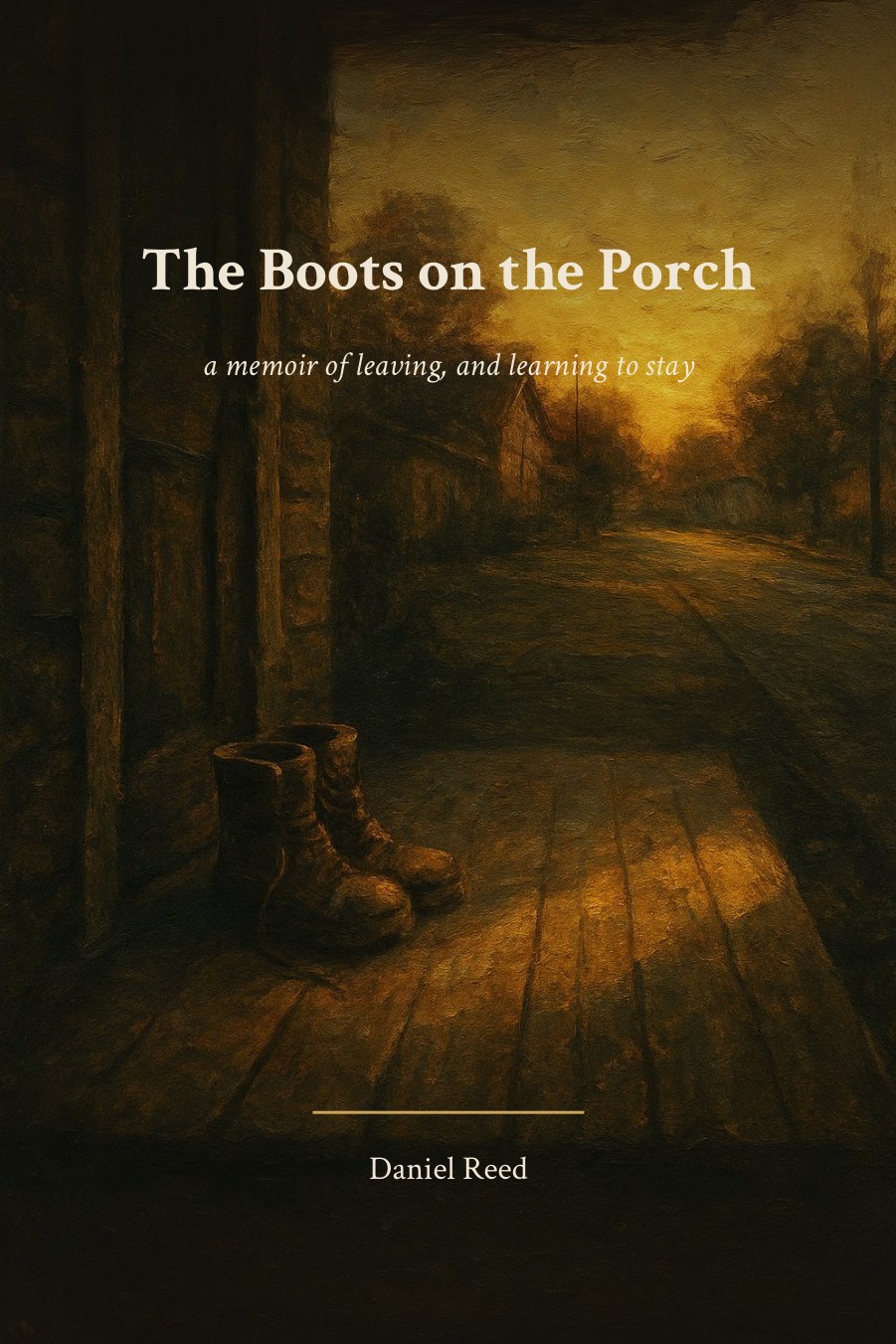
His own words became the title on the cover.
Your table of contents will share none of these — it can’t. It hasn’t been lived by anyone but you.
The hardest memory,
and what the book did with it.
The same storyteller carried heavier nights. At twelve, he stepped between his father’s fist and his mother — and decided, alone, that he was the man of the house now. Here is how he told the Scribe, and the three things his book did with it: honored the wound, exposed the pattern, and retired the armor.
“Three days is a long time when you’re twelve and you’re the only man left in the house… Nobody sat me down and told me I was the man of the house now. I just decided it, the way you decide a board’s plumb before you nail it — you check it once, you don’t argue with it after.” — Chapter Three, The Man of the House
“I was unbreakable, all right. That was never the lie. The lie was thinking unbreakable and alone had to be the same thing. Somewhere in all that building, I built a house nobody could really get into, and I put my own family in it, and called the distance between us love.” — Chapter Four, The Unbreakable One
“I want to say something about the unbreakable one before I put him down. He deserves that much… He kept that promise for forty years. I am alive because of him. But the unbreakable one was built for a fire that isn’t burning anymore.” — Chapter Seven, The Man Who Stays
Nothing invented. Nothing softened. The twelve-year-old’s courage stays courage; the armor gets thanked for its service — and then it gets to come off. That is the epiphany this platform is built to deliver.
Your tradition, woven with a light hand.
At the door, you choose: no religious language at all, gentle nods in your own vocabulary, or full integration — where the scripture of your tradition is quoted, cited, and woven in at the exact moments it meets your story. Not often. Precisely.
“And through it all, God had a plan.” — pasted at the end of every chapter, whether it belongs there or not.
“Forty years I wore armor I forged myself, and it held — that was never the problem. Then I finally read the old words slowly: ‘Put on the full armor of God, so that when the day of evil comes, you may be able to stand your ground’ — Ephesians 6:13. The boy who armored up at twelve had the right instinct all along. He just forged it out of the wrong metal.” — how full integration lands: scripture quoted and cited at the exact moment it meets the story’s own imagery. (Illustrative example, Christian tradition — the same care applies to whichever tradition is yours.)
Two or three such moments across a whole book — each one earned, each one placed where your faith actually lived. Never a sermon. Never someone else’s theology laid over your story. Woven right, it doesn’t read like a citation. It reads like the verse was waiting for you.
Built for the weight of real stories.
This process asks for the truth, so it was engineered to hold it — ethically, privately, and safely.
The Private Vault
Your raw words stay in a secured vault — never printed by default, never shared, never used to train anything. Raw truth belongs in the vault. Printed truth is stewarded.
Names, protected
The people who hurt you are masked by default in every printed edition. The people who loved you — the grandmother, the coach, the friend — can be honored by name, if you choose.
Paced for a nervous system
Pause and save at any moment. The Scribe detects distress and slows down, grounds you, never pushes deeper when you're overwhelmed. Stability before excavation.
Honest about what it is
This is a narrative transformation tool — not therapy, and it never pretends to be. Crisis resources stay visible throughout, and the process stops the moment safety matters more than story.
For the ones we lost.
And the ones still here.
This platform exists because of two people who aren’t here to see it.
Christopher Anaya Jr.
&
Tommy Chamberlain
Two people we loved reached a moment where the weight felt heavier than the light — where hope ran out. We miss them every single day. And we will always wonder: if they could have seen their own story reframed — if someone had helped them find meaning in what they carried instead of being crushed beneath it — would they still be here?
We can’t answer that for them. But we can build it for the next person who reaches that edge.
This is for the veteran who came home from one war and fights a quieter one, alone. For the person in recovery who has fallen again and believes they are beyond saving. For the woman starting over with everything she owns in a single bag, certain she will never feel whole again. For the man or woman walking out of a cell, determined that the next chapter will look nothing like the last. For the parent trying to break a cycle they were handed, so their children inherit something better. For the dreamer and the builder chasing a breakthrough, ready to face the belief that has quietly held them back.
And for everyone whose dreams went unlived, whose potential went unmet, whose love was lost and never grieved out loud — no one is left out of this. Wherever you are starting from, there is a next page for you.
And it is for the ones left behind — the parents, the families, the friends who carry a grief with no bottom to it. You matter here too. Your story deserves to be held with the same care.
If you are reading this and you are certain your story is already written — it isn’t. What happened to you is real, and it is heavy. But it is not the end of what your life means. There is a next page. Let’s write it together.
If you are struggling right now, you are not alone, and you do not have to carry it tonight. Call or text 988 — the Suicide & Crisis Lifeline, any hour of any day. Please stay.
It meets you wherever you are.
Whatever you have lived through — loss, abuse, addiction, betrayal, war, the things you have never said out loud — this holds it with care. It goes as deep as you are ready to go and no deeper, and it gives you tools to carry what is yours and set down what was never yours to begin with.
For some people this is the whole turning point. For others it is one powerful part of a longer healing. Either way, you leave with your story reframed and a way forward in your hands — not just insight, but something to do with it.
If you are in crisis or in danger right now, please reach out first: call or text 988 (Suicide & Crisis Lifeline), or 911 if you are in immediate danger. This platform holds hard things with you, and it will always point you toward a real person when that is what you need. It walks beside professional care, never in place of it.
Yours alone. Yours to share.
Yours to publish.
Your story belongs to you in every sense — and what you do with it is entirely your choice. Most people begin with the first path. You never have to take another step than the one you want.
Kept completely to yourself. A private reckoning — to understand your own patterns, learn the tools to cope and overcome, and hold who you are becoming in your hands. No one ever has to see a word of it. This is what it is for, first and foremost.
Given to the people who love you. Hand your book to your children, your partner, your closest friends — and let them finally see the whole of you, the road you walked, the person underneath. Some things are easier to give on a page than to say out loud.
Shared with the world, if you choose. Your story can reach a larger audience and even earn for you — because you own the full rights. Your pain, reframed, might be exactly what frees someone you'll never meet. Entirely optional, entirely yours.
You own the copyright, the life-story rights, all of it. Keep it in a drawer forever, or put it on a shelf in a bookstore. The door only opens the way you decide.
Your story frees another.
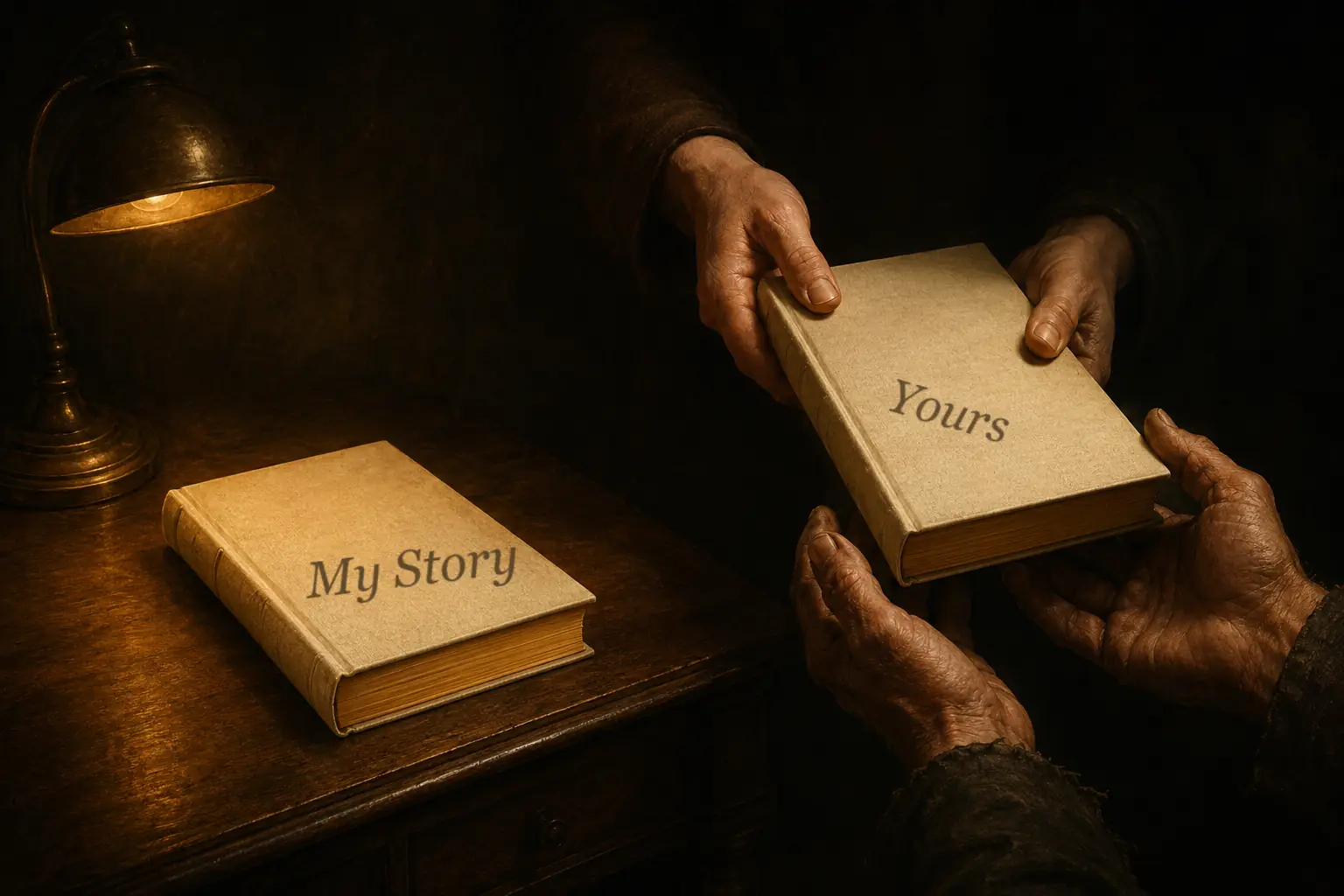
Every founding edition carries a second journey inside it — given whole, and given free, to someone fighting for their own second draft. A veteran carrying what the war wouldn't put down. A woman starting over in a shelter, rebuilding a life from what fit in one bag. Someone in treatment, telling the truth about their life for the first time.
The same Scribe. The same reveal. The same hardcover in their hands. You will never know their name, and they will never know yours — but because you faced your story, somewhere, someone gets to face theirs.
Gifted journeys are placed through partner treatment centers, veterans' organizations, and women's shelters.
One story rewritten. One story given.
"For years I lived inside the worst stories of my life — so those were the stories I kept repeating: the same people, the same chaos, over and over. Everything changed the day I started telling a truer story about what it all meant. I still share the old ones when they can help someone — I just don't live there anymore. That's what this platform is for: to help you find the story that sets you free, and everyone who loves you along with it."
Start with the Seven Passages.
A free guided reflection — the same seven passages the journey walks through, as honest questions you can sit with tonight, with a pen and twenty quiet minutes. Printable, and yours to keep.
Your guide is ready: download the Seven Passages (PDF). A copy and a few short letters will follow by email.
We’ll email you the guide and a few short letters about the journey. Unsubscribe anytime. We never sell your email, and nothing you write in the guide ever reaches us.
Or read it online right now.
Before you begin
Do I need to be a writer?
No — and that's the point. You give memories, moments, and honest answers. The Scribe asks the questions that draw out detail you didn't know you remembered, then writes the book. You are the source of truth. The Scribe is the literary talent.
Is this therapy?
No. This is a structured self-reflection and narrative transformation process — serious, trauma-informed, and carefully paced, but it is not clinical treatment and never replaces it. If you're in crisis, call or text 988 first. The platform will tell you the same thing.
How long does it take?
The core journey is two to three hours of guided conversation — taken in one sitting or across as many sessions as you need. Your story is saved at every step, and deeper memories often surface after a pause. There is no rush and no deadline.
What about the people in my story?
Anyone connected to harm or accusation is masked by default in every printed edition — roles instead of names, details generalized so they can't be deduced. People you want to honor can appear by real name, with your explicit choice. Protect first. Honor carefully. Never expose casually.
Who owns the book?
You do. Full copyright, life-story rights, and film rights stay with you. Your first edition is private by default. If you ever decide your story could help others, publishing support is available — as an option, never the goal.
Who receives the donated journeys?
We partner with addiction-treatment programs, veterans' organizations, and recovery communities to place gifted journeys where they can do the most good — often alongside a counselor or group leader. One thing we will never do: market with recipients' stories. We tell the story of the program, never the stories of the people it serves.
What if I change my mind?
Walk the first passage, Origin. If it isn't what you hoped, email support@rewriteyourstory.ai within 14 days of purchase and every dollar comes back. Once you step into Passage II, or on day 15, your founding edition is final — and the journey you’re giving opens at that same moment, so a refund never takes anything away from anyone else.
What if it gets heavy?
The process is built for that. You can pause and save at any moment. The Scribe watches for distress in your words and responds by slowing down and grounding you — never pushing deeper. Crisis resources (call or text 988) stay one glance away through the entire journey.
The book. The understanding. Every road, priced.
A ghostwriter can hand you the book without the understanding. Years of therapy can hand you the understanding without the book. Writing alone, for most people, ends in neither. Here is the honest landscape — what each road costs, how long it takes, and what you hold at the end.
Ghostwriting and therapy figures reflect typical professional rates; many run far higher. To be clear about the therapy row: therapy remains irreplaceable for what therapy is for — crisis, clinical care, a human across the room — and this platform walks beside it, never instead of it. But the specific work of seeing your pattern and reframing what your story means is exactly what this was built to deliver: a ghostwriter types your story, the Scribe helps you change what it means. And only this road carries a second journey, given in your name — at any price.
Your transformation, bound in hardcover.

- The hero's journey of your actual life — seven passages with the Scribe, as many sessions as your story needs. Nothing rushed, nothing skipped.
- Your traumas, reframed into fuel — not denied, not dressed up, not explained away. Reworked until the very things that held you back drive you forward.
- Your memoir, fully written — 100–300 pages in your own voice. A professionally ghostwritten memoir starts around $8,000 and climbs past $25,000.
- The hardcover, shipped to your door — classic 6×9 trade binding, cover art conjured from your story or your own photograph. Founding copies carry the Founding Edition imprint, printed only in the first hundred books.
- Every right, forever — copyright, life-story rights, film rights. Publish it, gift it, or keep it in a drawer. Yours.
- A second story, given — the identical journey placed free with a veteran, a woman in a shelter, or someone in treatment. In your name.
One payment. $397. No subscription. No upsell required to finish your book.
The founding edition closes when the first 100 books ship. The price becomes $497 — and the first-edition imprint never returns.
Your life wasn't random. Your patterns weren't accidents.
Your pain wasn't meaningless.
Now you see it. Now you choose.